BEYOND THE SCREEN mit Su Erdt
The production designer on creating cinematic realities
21.01.2026
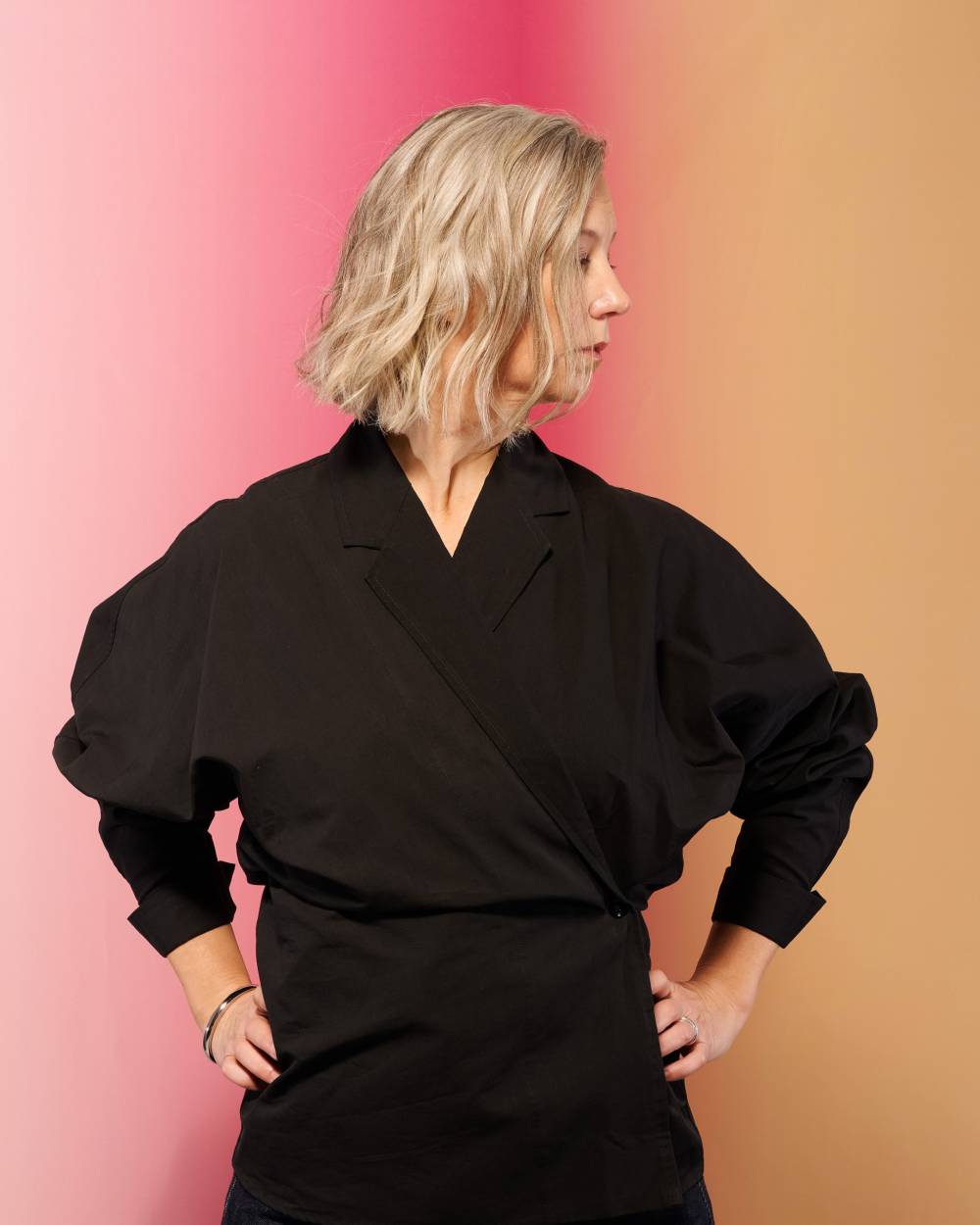
Su Erdt has been working as a freelance production designer since 2004 in Germany and abroad and was responsible for the production design for HALLO BETTY and STILLER, among others. She was honoured with the Special Academy Award for ZWINGLI at the Swiss Film Awards in 2019. Her latest work can be seen in Petra Volpe’s current film FRANK & LOUIS, which is celebrating its world premiere at the Sundance Film Festival.
.jpg)
Did you plan to work in film from the beginning?
After completing my studies as a set designer, I was initially drawn to the theatre. In my early twenties, I received an offer for an internship in set design for a film, but I turned it down: I couldn’t imagine what film was like and preferred to get involved in off-theatre and art projects as a stage designer, stage design assistant and prop master. At the time, that was ‘the place to be’ for me. After a few years of barely scraping by, spending many hours in dark rehearsal rooms, working irregular hours and doing side jobs as a set designer, I decided to help out with the set design for a graduation film. It was out of curiosity, and I was immediately hooked! I then completed a master’s degree in Scenographical Design at Central Saint Martins College of Art and Design in London. That was my final stepping stone into the film industry.
Why did you end up choosing production design?
Since I have always been interested in spaces, spatial staging, light, design, architecture and stylistics, it was not a choice but simply a logical consequence. Creating mood, atmosphere and microcosms using locations, spaces, colours and textures has always fascinated me. What I liked about film was the long preparatory work and the interaction between all the teams for that one moment on set when suddenly everything comes together, creating a space that gives depth and form to the narrative and characters. All of this still inspires me even today.
Films sometimes remind me of dreams; much of it is not always clearly tangible. Subtext and atmosphere intuitively influence perception, which I also find exciting in design and its implementation. It’s often the details that make the difference, even if they are not necessarily prominent. The longer I work in this profession, the more precise my awareness of this becomes.
You were the production designer for Petra Volpe’s FRANK & LOUIS. What kind of reality did you try to create?
Petra and I have already worked together on several films, and we share professional standards and working methods as well as a great deal of trust, respect and friendship.
The difficulty was that the story is set in a US prison, but we had to shoot in England and, for financial reasons, also in Switzerland. In the UK, there were only 3-4 empty prisons available for filming. Most of them were very old and had a typical old English look. The prison museum in Shrewsbury offered the best options because of its different wings. I did a lot of research online, and Petra had also collected years of research material in the US, among other places, at California Men's Colony Prison, to understand what the crucial American details were.
It was essential for the story to create a cold, confining and inhospitable environment in which the characters would appear like animals in enclosures. Under such conditions, it is a daily, personal struggle to remain human and, as the story tell us, to find empathy and charity.
Reducing the colour scheme to shades of yellow, blue, grey and white helped to achieve this; colours that often appear in prisons in the US and evoke a feeling of uniform stringency. The costumes also play a key role here.
Furthermore, details such as lettering, graphical prop design and even American electrical sockets were important. Actually, the English art department created almost everything that is used in the very sparse spaces.
Then in Switzerland, we recreated part of the UK prison in an empty hall. In terms of the details, it was a real challenge. Shrewsbury Prison was built in 1877 and has been rebuilt and expanded countless times since then. So it was very important to reconstruct the texture and precise details accurately. I hope, of course, that everything will come together seamlessly. I haven’t seen the finished film yet and am very excited!
What role does AI play in your profession?
AI will become increasingly prevalent. Positions such as graphic design, concept drawing and research will become more efficient thanks to AI but will certainly have an impact on pay. I use AI tools here and there in my research, but I haven’t used image generators that much so far. Among other things, I’m concerned about the mediocre aesthetics of AI. Personally, I still find it more rewarding to discover unexpected things that inspire new ideas when I have limited time in a (digital) image archive, museums, etc. For me, chance harbours tremendous creative potential.
AI already plays an integral role in virtual production. To help shape visual effects (VFX), it is important to be involved in the processes as a designer. Sometimes you only see what has been added in the background when you watch the finished film, and it’s not what I had in mind. That’s why I think it’s important to continue learning in this area. I’ll be forced to deal with it at some point, so I’d rather do it voluntarily now.
What role do awards play for you?
Receiving an award for your work, with or without money, is a wonderful and motivating form of recognition. In this context, I would like to mention that the Swiss Film Awards still do not have an award category for set design, costumes and make-up, even after repeated attempts by our professional association. Switzerland is probably one of the few European countries, apart from Denmark, that does not award prizes in these categories.
Under these circumstances, the Special Academy Award, which I won in 2019 together with costume designer Monika Schmid for our work on the Zwingli film, felt like a very special and treasured moment.
Freely paraphrasing from ‘The Good, the Bad, and the Ugly’, how would you describe your work?
The Good: I love immersing myself in research and design in the early stages of a project. I build the world in my mind’s eye, creatively and inspirationally. It’s where my passion for a project develops. In recent years, I have had the opportunity to take on many exciting and historical projects. I love history because it allows me to indulge my interest in history, eras, stylistics and time travel. It is still my dream job.
The Bad: Unfortunately, the job also comes with frequent stress, time and performance pressure, sleepless nights, potentially difficult team constellations, and weeks away from family and friends. You may be at the mercy of difficult or unprofessional working conditions. A high degree of flexibility is a prerequisite for project planning, oftentimes short-term. If projects suddenly overlap or are even cancelled, this also has an impact on financial security. As a result, work-life balance can sometimes fall by the wayside for months on end. So you also need a pinch of masochism!
The Ugly: When a film project that I am involved in for only a short period of time and for which I am jointly responsible simply doesn’t work out in the end, or when the film disappears from cinemas after a very short time, or when the reviews are bad, it can sometimes be frustrating. Film is a complex art form, and masterpieces are rare and fascinating exceptions!